
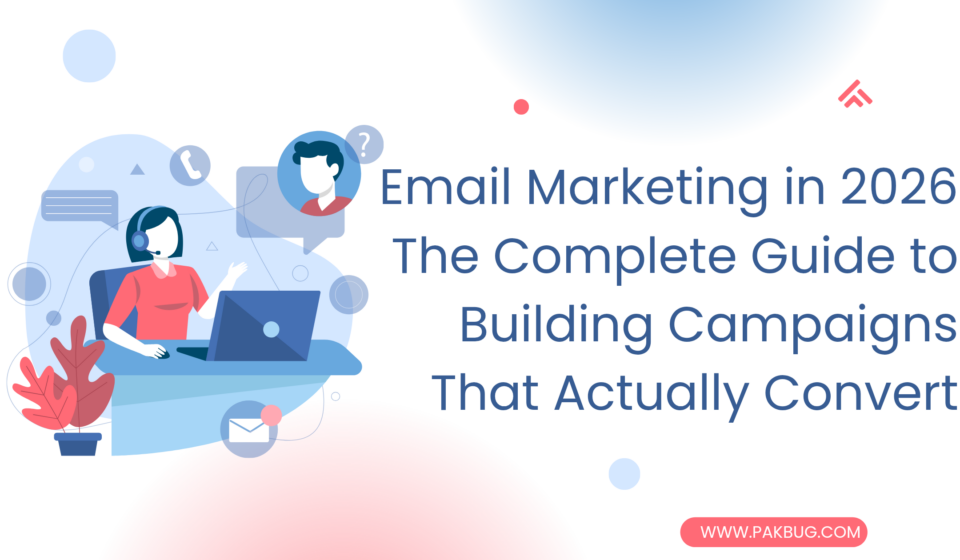
Email Marketing in 2026: The Complete Guide to Building Campaigns That Actually Convert

Email marketing is one of the oldest tools in the digital marketer’s toolkit — and yet, it continues to outperform almost every other channel when it comes to return on investment. While social media algorithms change overnight and paid ads drain budgets fast, a well-built email list remains an asset you truly own. In this guide, we’ll walk through everything you need to know to build, grow, and monetize an email marketing strategy in 2026.
Table Of Content
- Why Email Marketing Still Matters
- Step 1: Choose the Right Email Marketing Platform
- Step 2: Build Your Email List the Right Way
- Optimize Your Sign-Up Forms
- Never Buy an Email List
- Step 3: Write Emails People Actually Open
- Nail the Subject Line
- Write Like a Human
- The Preview Text Trick
- Step 4: Set Up Automated Email Sequences
- The Welcome Sequence
- Nurture Sequences
- Abandoned Cart Emails
- Re-Engagement Campaigns
- Step 5: Segment Your List for Better Results
- Step 6: Track the Right Metrics
- Step 7: Stay Compliant with Email Laws
- Email Marketing Trends to Watch in 2026
—
Why Email Marketing Still Matters
With so many shiny new platforms competing for attention — TikTok, YouTube Shorts, AI-powered chatbots — it’s easy to overlook email. But the numbers tell a different story.
Email marketing consistently delivers an average return of $36 to $40 for every $1 spent. That’s not a typo. The reason is simple: people who subscribe to your list are already interested in what you have to offer. They’ve raised their hand and said, “Yes, I want to hear from you.” That kind of intent is hard to replicate anywhere else.
Beyond ROI, email gives you:
– **Direct access** to your audience without paying a platform middleman
– **Personalization** at scale, from first names to product recommendations
– **Measurable results** — open rates, click rates, and conversions are all trackable
– **Ownership** — your list isn’t subject to algorithm changes or account bans
—
Step 1: Choose the Right Email Marketing Platform
Before you send a single email, you need a platform to manage your subscribers, design campaigns, and track performance. Here are some of the most popular options in 2026:
*Mailchimp* — Great for beginners. Has a free tier and drag-and-drop editor. Ideal for small businesses getting started.
*ConvertKit (now Kit)* — Built for creators, bloggers, and online course sellers. Excellent automation features.
*Brevo (formerly Sendinblue)* — Strong free plan with SMS integration. Good for eCommerce brands.
*ActiveCampaign* — Best-in-class automation for growing businesses. More of a learning curve but very powerful.
*MailerLite* — A clean, affordable option with a generous free plan. Popular with bloggers and small teams.
Pick the one that fits your current budget and goals. You can always migrate later as your list grows.
—
Step 2: Build Your Email List the Right Way
The health of your email list matters more than the size. A list of 1,000 engaged subscribers will outperform a list of 10,000 uninterested ones every single time.
Use a Lead Magnet
A lead magnet is a free resource you offer in exchange for someone’s email address. It should solve a specific problem for your target audience. Popular lead magnets include:
– Free eBooks or PDF guides
– Checklists and templates
– Mini email courses
– Discount codes or coupons
– Free webinars or video trainings
– Quizzes with personalized results
Make your lead magnet genuinely useful. If someone downloads it and finds real value, they’ll look forward to your next email.
Optimize Your Sign-Up Forms
Place opt-in forms where your audience already is:
– The top of your homepage
– Within or at the end of blog posts
– As a pop-up (use exit-intent triggers to avoid being intrusive)
– On your “About” page
– In your website’s footer
Keep the form simple. Asking for a name and email is usually enough. The more fields you add, the fewer people will complete it.
Never Buy an Email List
Purchased lists are a shortcut that backfires every time. Those people never asked to hear from you, which means high spam complaints, low engagement, and potential damage to your sender reputation. Build your list organically — it takes more time, but the results are dramatically better.
—
Step 3: Write Emails People Actually Open
Getting subscribers is just the beginning. Now you need to earn their attention every time you show up in their inbox.
Nail the Subject Line
Your subject line is the single most important factor in whether your email gets opened or ignored. Keep these principles in mind:
– **Be specific**: “3 ways to grow your blog traffic this week” beats “Tips for bloggers”
– **Create curiosity**: Tease a benefit without giving everything away
– **Keep it short**: Aim for under 50 characters so it displays well on mobile
– **Avoid spam triggers**: Words like “FREE!!!” or “CLICK NOW” can send you straight to junk folders
– **A/B test**: Send two versions to a small segment and see which one wins before broadcasting to your full list
Write Like a Human
The biggest mistake email marketers make is sounding like a corporate press release. Your subscribers are people, not demographics. Write the way you’d talk to a friend — conversational, direct, and genuine.
Start with a hook. Address a problem your reader is facing. Then move naturally into your message. End with a single, clear call to action. Don’t cram five different offers into one email — pick one goal and stick to it.
The Preview Text Trick
The preview text (the snippet that appears next to your subject line in the inbox) is often wasted. Instead of letting it default to “View this email in your browser,” write a custom line that complements your subject and adds more context. This small tweak can noticeably boost your open rates.
—
Step 4: Set Up Automated Email Sequences
Automation is where email marketing goes from good to great. Instead of sending manual campaigns every time, you create sequences that run automatically based on what a subscriber does.
The Welcome Sequence
When someone joins your list, don’t go silent. Set up a welcome sequence — typically 3 to 5 emails sent over the first week — that:
1. Thanks them for subscribing and delivers the lead magnet
2. Introduces you and your brand story
3. Sets expectations (what will they receive and how often?)
4. Provides your best content or resources
5. Includes a soft offer or invitation to connect further
First impressions stick. A strong welcome sequence builds trust and engagement from day one.
Nurture Sequences
Not every subscriber is ready to buy immediately. A nurture sequence educates and builds relationships over time, gradually moving prospects toward a purchase decision. These can run for weeks or even months, sharing helpful content, case studies, testimonials, and value-driven emails before making an offer.
Abandoned Cart Emails
For eCommerce businesses, abandoned cart emails are among the highest-converting automations available. If someone adds items to their cart but doesn’t check out, a well-timed reminder email — ideally within an hour — can recover a significant percentage of those sales.
Re-Engagement Campaigns
Over time, some subscribers go cold. They stop opening emails and lose interest. Rather than let them sit on your list and drag down your metrics, run a re-engagement campaign. Send a direct email acknowledging their absence, offer something valuable, and ask if they still want to hear from you. Those who don’t respond can be removed — keeping your list healthy and your sender reputation intact.
—
Step 5: Segment Your List for Better Results
Segmentation means dividing your subscribers into smaller groups based on shared characteristics, and sending each group more relevant content.
You can segment based on:
– How they joined your list (which lead magnet they downloaded)
– Location or language
– Purchase history
– Engagement level (active vs. inactive subscribers)
– Interests or preferences (collected via a survey or quiz)
Segmented campaigns consistently generate higher open rates, higher click rates, and more revenue than one-size-fits-all broadcasts. The more relevant your emails feel, the better they perform.
—
Step 6: Track the Right Metrics
Email marketing without measurement is just guessing. Here are the key numbers to monitor:
**Open Rate** — The percentage of recipients who opened your email. A good benchmark varies by industry, but 20–30% is generally considered healthy.
**Click-Through Rate (CTR)** — The percentage who clicked a link inside your email. This measures how compelling your content and call to action are.
**Conversion Rate** — The percentage who completed a desired action (purchase, sign-up, download). This is the ultimate measure of whether your email achieved its goal.
**Unsubscribe Rate** — A high unsubscribe rate signals your content isn’t matching audience expectations. Over 0.5% on a regular send is worth investigating.
**Bounce Rate** — Hard bounces (invalid email addresses) should be removed immediately. A high bounce rate damages your sender reputation.
Review these metrics after every campaign. Look for patterns, test new approaches, and continuously improve.
—
Step 7: Stay Compliant with Email Laws
Email marketing is regulated in many countries, and ignoring the rules can result in heavy fines and account suspensions.
The main regulations to be aware of:
– **CAN-SPAM Act (USA)** — Requires a physical address, a clear unsubscribe option, and honest subject lines
– **GDPR (European Union)** — Requires explicit consent from subscribers before you email them
– **CASL (Canada)** — One of the strictest laws; requires express consent for commercial messages
– **PTA/PEMRA regulations (Pakistan)** — Always use permission-based marketing and honor unsubscribe requests promptly
Best practices to stay compliant: always get clear consent, include your business name and address in every email, make unsubscribing easy, and never use misleading subject lines.
—
Email Marketing Trends to Watch in 2026
The email landscape keeps evolving. Here are a few trends shaping the industry right now:
**AI-Powered Personalization** — Tools now use machine learning to predict the best send time for each individual subscriber, personalize subject lines dynamically, and recommend products based on behavior.
**Interactive Emails** — Embedded polls, sliders, and even shopping carts directly inside emails are becoming more common as email clients improve their support for interactive elements.
**Plain Text Comeback** — As beautifully designed HTML emails become the norm, many marketers are finding that simple, plain-text emails feel more personal and generate higher engagement.
**Zero-Party Data** — With third-party cookies disappearing, collecting data directly from your audience (through surveys, quizzes, and preference centers) is becoming critical for personalization.
**Hyper-Segmentation** — Broad segments are giving way to micro-segments. The most successful email programs in 2026 treat subscribers as individuals, not just categories.
—
Email marketing isn't glamorous. It doesn't come with viral moments or trending hashtags. But it works — reliably, consistently, and profitably — when done with intention.


Start by choosing the right platform, building your list with value, and writing emails that actually help people. Automate what you can, measure what matters, and always keep your subscribers' needs at the center of every decision.


Your email list is one of the most valuable assets your business can have. Treat it

that way, and it will pay you back many times over.